The last time Vietnam's Communist Party met for its all-important five-yearly national congress, Twitter, the 140 character micro-blogging service, was yet to launch.
So prepare for a social media first, when I "live tweet" the 11th party congress, which begins on Wednesday at Hanoi's rather smart National Convention Centre.
Granted the bar hasn't been set that high. I didn't see any other journalists using Twitter at the pre-event press conference on Monday and Twitter isn't yet that popular in Vietnam (though that may change if Facebook continues to be blocked - some people have started bypassing the block by using Twitter to update their Facebook page).
But it's still going to be a first, provided I can get a mobile phone signal.
Read all about it at http://twitter.com/benjaminbland.
For a sneak peek inside the congress venue, check out this blog I wrote for the FT's Beyond Brics.
Showing posts with label politics. Show all posts
Showing posts with label politics. Show all posts
Wednesday, January 12, 2011


Sunday, October 18, 2009
Singapore's hidden heartland - full version now available on WSJ website
The full version of my piece on Singapore's little-known farming heartlands, which was published in October's Far Eastern Economic Review, is now available for free on the Wall Street Journal website here.
Below is the intro:
Below is the intro:
The car weaves along the winding country lane, cutting a narrow path through the lush tropical vegetation. As well as the occasional dog ambling sleepily down the roadside, we pass farm after farm producing everything from vegetables to goat's milk and even crocodiles. We reach the summit of a short incline from where the gently-undulating landscape stretches out in front of us, punctuated only by farm buildings and electricity pylons.
Briefly, it's almost possible to imagine that I'm in one of Asia's expansive agricultural heartlands such as Malaysia's Cameron Highlands or Vietnam's Mekong Delta. But the frequent road signs warning people away from state land and urging trespassers not to enter "protected areas" at risk of being shot give the plot away.
Welcome to Singapore's last remaining slice of rural life: the Kranji countryside. The Southeast Asian city-state may be better known for its banks, shopping malls and sprawling public housing estates but here, in the northwestern corner of the island, Singapore's hardy farmers struggle on, producing 18,000 tons of vegetables, 47 million chickens, millions of eggs and 5,000 tons of fish each year.
"There's no PAP up here -- we're not prim and proper," quips Ivy Singh-Lim, president of the Kranji Countryside Association (KCA), as she pokes fun at Singapore's ruling People's Action Party, which has maintained a tight and, critics say, stifling grip on power since Britain granted self-rule in 1959.
Saturday, October 10, 2009
Time for Anwar Ibrahim to become a benevolent dictator?
Raja Petra Kamarudin, the outspoken Malaysian blogger and fugitive, argues in his latest blog posting from wherever in the world he's hiding that Malaysia's disparate opposition coalition needs to develop some discipline if it is to have any hope of winning power.
![]()
Since last year's surprise election result, when the ruling Barisan Nasional lost its two-thirds majority, the Pakatan Rakyat grouping - composed of a Chinese pro-democracy party, an Islamic party and a multi-racial party led by former deputy PM Anwar Ibrahim - has spent as much time fighting internal battles as it has taking on the government.
RPK thinks Anwar needs to firm up the loose coalition into an official party and stamp some authority on the party members if it is to beat Prime Minister Najib Razak - noted for his authoritarian streak - at its own game.
That, I presume, is what has prevented Anwar from cracking the whip thus far.
Anwar's critics would say, of course, that his dictatorial instincts are not buried too deep beneath the surface so shouldn't be that difficult to recover.
Photo courtesy of Flickr user KamalSell.

RPK thinks Anwar needs to firm up the loose coalition into an official party and stamp some authority on the party members if it is to beat Prime Minister Najib Razak - noted for his authoritarian streak - at its own game.
I always said there are times when we need a dictator to lead us. But then, what kind of dictator are we talking about? There are malevolent dictators and there are benevolent dictators. Malevolent is bad. Benevolent is good. So, while dictators are normally seen in a negative light, we can’t just discount all dictators as bad. We have good dictators and we have bad dictators.He concludes:
I would take a benevolent dictator any time over someone who stands by and does nothing. More damage and injustice is done when someone takes no action. When there is racism and racial skirmishes resulting in the deaths of many innocent women and children, doing nothing is worse than clamping down with a heavy hand.
Yes, it is time Pakatan Rakyat not only registers as a legal entity but also crack the whip. We need discipline in the opposition. Sit down and agree on the policies. Bang tables if need be. But once a consensus has been reached and the three opposition parties have agreed on an unanimous decision, let no party leader try to torpedo all this by going off tangent. Rule ruthlessly, with a dictator’s hand, but a benevolent dictator at that.Interesting view. The major problem is that any attempt to instill conformity on a rather uncomfortable rainbow coalition composed of Islamists, liberal democracy activists and assorted anti-government types may lead to the break-up of said grouping.
That, I presume, is what has prevented Anwar from cracking the whip thus far.
Anwar's critics would say, of course, that his dictatorial instincts are not buried too deep beneath the surface so shouldn't be that difficult to recover.
Photo courtesy of Flickr user KamalSell.
Monday, October 5, 2009
Hossan Leong: Singapore’s latter-day court jester
Though it’s hard to believe, there are some places in Singapore where people openly mock their rulers, who retain strict controls over the media and have shown a tendency to use the libel law against those who do them down.
On Saturday, I watched Singaporean comic Hossan Leong gently poking fun at Minister Mentor Lee Kuan Yew and his family and briefly mocking the government’s economic and racial policies and the failure to prevent terrorist Mas Selamat from escaping last year.
In the West, such ribbing would be considered tame in the extreme. But in Singapore, this was pushing the boundaries of political humour about as far as they can go or at least as far as most people are willing to push them.
The vast majority of Hossan Leong’s performance, which was set up as a spoof chat show, was decidedly non-political. But, still, he was only allowed to get away with breaking such taboos because of two reasons:
1. He was performing in a theatre – While the government censors take a very strict view of what can be shown/written about in the mass media, they are much more relaxed about a medium that plays to a limited and largely elite audience. Only 615 people can fit in to the National Library Drama Centre, where Leong’s show was playing, so at best fewer than 10,000 will be get to see it during this ten-day run. More importantly, most theatre-goers come from the upper echelons of the middle class and the government is more relaxed about allowing this narrow elite a bit more personal freedom.
2. The political humour was interspersed by copious amounts of cross-dressing, stupid songs and all-round pantomime silliness. Thus any hard message behind the political humour was diluted and deliberately deprived of any semblance of legitimacy.
To put it another way, Leong is adopting the role played by court jesters in England during the Middle Ages.
While the people were forbidden from speaking ill of the monarchy – sometimes on pain of death – the jesters were allowed free reign to mock and parody because it was accepted that anything they said was “in jest” and that they were merely the court fool.
On Saturday, I watched Singaporean comic Hossan Leong gently poking fun at Minister Mentor Lee Kuan Yew and his family and briefly mocking the government’s economic and racial policies and the failure to prevent terrorist Mas Selamat from escaping last year.
In the West, such ribbing would be considered tame in the extreme. But in Singapore, this was pushing the boundaries of political humour about as far as they can go or at least as far as most people are willing to push them.
The vast majority of Hossan Leong’s performance, which was set up as a spoof chat show, was decidedly non-political. But, still, he was only allowed to get away with breaking such taboos because of two reasons:
1. He was performing in a theatre – While the government censors take a very strict view of what can be shown/written about in the mass media, they are much more relaxed about a medium that plays to a limited and largely elite audience. Only 615 people can fit in to the National Library Drama Centre, where Leong’s show was playing, so at best fewer than 10,000 will be get to see it during this ten-day run. More importantly, most theatre-goers come from the upper echelons of the middle class and the government is more relaxed about allowing this narrow elite a bit more personal freedom.
2. The political humour was interspersed by copious amounts of cross-dressing, stupid songs and all-round pantomime silliness. Thus any hard message behind the political humour was diluted and deliberately deprived of any semblance of legitimacy.
To put it another way, Leong is adopting the role played by court jesters in England during the Middle Ages.
While the people were forbidden from speaking ill of the monarchy – sometimes on pain of death – the jesters were allowed free reign to mock and parody because it was accepted that anything they said was “in jest” and that they were merely the court fool.
Friday, October 2, 2009
Armed with short skirts and leather boots, China's Women's Liberation Army make its debut
Was anyone else watching China's national day parade surprised to see the massed ranks of short skirt and leather boot-clad female soldiers goose-stepping through Tiananmen Square?
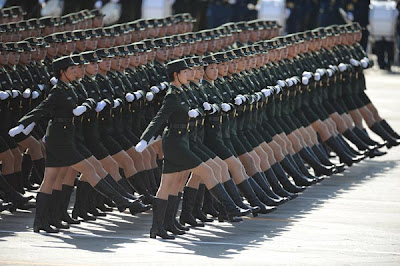
For a brief second, I though I was watching an Austin Powers or Carry On film - come to think of it, Carry On People's Liberation Army has a certain ring to it.
Obviously women soldiers have played a key role in previous military parades in China but for this year's extravaganza, the requirements for female participants were altered from just being "brave" to being "brave, beautiful and elegant", according to state TV channel CCTV.
Presumably, the powers that be thought that the best way to honour Mao's legacy and pay tribute to China's transformation was to get some lovely ladies showing a bit of leg.
Given exclusive access to the women's preparations, a CCTV reporter found that "the female soldiers on the training ground are as good as the male soldiers in doing leg lifts and other movements".
But, unlike the lads, the ladies have some additional equipment they are required to carry on top of their weapons.
"We consider sun cream and other skin care products necessities," the leader of the female soldiers Chang Donghua told CCTV.
Photo from Xinhua. More photos here.

Obviously women soldiers have played a key role in previous military parades in China but for this year's extravaganza, the requirements for female participants were altered from just being "brave" to being "brave, beautiful and elegant", according to state TV channel CCTV.
Presumably, the powers that be thought that the best way to honour Mao's legacy and pay tribute to China's transformation was to get some lovely ladies showing a bit of leg.
Given exclusive access to the women's preparations, a CCTV reporter found that "the female soldiers on the training ground are as good as the male soldiers in doing leg lifts and other movements".
But, unlike the lads, the ladies have some additional equipment they are required to carry on top of their weapons.
"We consider sun cream and other skin care products necessities," the leader of the female soldiers Chang Donghua told CCTV.
Photo from Xinhua. More photos here.
Wednesday, September 30, 2009
The man who called Lee Kuan Yew a dictator to his face
William Safire, the former speech writer for Richard Nixon and New York Times columnist who died on Sunday aged 79, was known as a pugnacious commentator.

There are perhaps few better examples of this than his interview with Lee Kuan Yew, Singapore's founding father, at the World Economic Forum in 1999, when he called Lee a dictator and accused him of showing disregard for the principles of liberal democracy.
In Safire's word's: "The determinedly irreplaceable Lee Kuan Yew is the world's most intelligent, and to some most likable despot."
Lee's response to the accusation of dictatorship was "do I need to be a dictator when I can win, hands down?".
Safire's New York Times piece on the interview is online here, while a full transcript of the interview has been posted here.
There are some real gems in here, such as when Safire asks whether Lee's son (Lee Hsien Loong) would be deputy prime minister [as he was in 1999] if it wasn't for the familial connection. [Lee junior was sworn in as Singapore's third PM in 2004.]
Lee responds: "If he were not my son, he would be the Prime Minister. I'll tell you honestly, I stopped him, because he can run faster than any of the others. But I told him it would do him no good. Just stay out of this race. And his generation, his peers, know that I am not boasting when I tell you this."
Then, Safire asks whether Lee forsees a dynasty. Lee replies:
"I am not that bereft of satisfaction with my life that I need to live vicariously through him. In fact, if he doesn't measure up, it is better that he does not show up, because he'll just besmirch the family reputation."
Lee also talks in the interview of the need to restrict the flow of online content to the "lumpen mass" of 30%-40% of Singaporeans who are not well-educated. [Just 15% of Singaporeans were using the internet back in 1999, compared to 76% today.]
"We don't want this barrage day after day ... the society has got to adjust and evolve step by step."
Hat-tip to Reme Ahmad, assistant foreign editor at the Straits Times, and his personal blog.
Photo courtesy of Flickr user No Use For a Name.

In Safire's word's: "The determinedly irreplaceable Lee Kuan Yew is the world's most intelligent, and to some most likable despot."
Lee's response to the accusation of dictatorship was "do I need to be a dictator when I can win, hands down?".
Safire's New York Times piece on the interview is online here, while a full transcript of the interview has been posted here.
There are some real gems in here, such as when Safire asks whether Lee's son (Lee Hsien Loong) would be deputy prime minister [as he was in 1999] if it wasn't for the familial connection. [Lee junior was sworn in as Singapore's third PM in 2004.]
Lee responds: "If he were not my son, he would be the Prime Minister. I'll tell you honestly, I stopped him, because he can run faster than any of the others. But I told him it would do him no good. Just stay out of this race. And his generation, his peers, know that I am not boasting when I tell you this."
Then, Safire asks whether Lee forsees a dynasty. Lee replies:
"I am not that bereft of satisfaction with my life that I need to live vicariously through him. In fact, if he doesn't measure up, it is better that he does not show up, because he'll just besmirch the family reputation."
Lee also talks in the interview of the need to restrict the flow of online content to the "lumpen mass" of 30%-40% of Singaporeans who are not well-educated. [Just 15% of Singaporeans were using the internet back in 1999, compared to 76% today.]
"We don't want this barrage day after day ... the society has got to adjust and evolve step by step."
Hat-tip to Reme Ahmad, assistant foreign editor at the Straits Times, and his personal blog.
Photo courtesy of Flickr user No Use For a Name.
Tuesday, September 29, 2009
Britain's "relegated" Labour party finally finds its form
Given that Britain's Labour party is almost certainly on its way out in next year's general election, it may seem bizarre to some that the tone at this year's party conference has been almost ebullient, with even the supreme miserablist Gordon Brown getting a few laughs during his speech.

Is this merely the arrogance of those who have been in power for 12 years and have no regard for the pathetic ants who make up the electorate?
No. Football fans will immediately recognise this behaviour as post-relegation syndrome.
As soon as it's mathematically impossible for your team to stay up (a sadly too frequent occurence for Brentford fans like myself), the players, who have looked like they are queuing up to be euthanised all season, suddenly spark into life, freed from the fear and pressure that comes with the hope of success.
Once they know it's over, they appear as born-again as any Christian, willing and able to take on even the best teams in the league and win.
Which brings me back to the Labour party. With no chance of victory in the election, a load has been lifted off the party faithful's shoulders.
Now they can sit back, relax and envelop themselves in the comforting bosom of self-congratulation, promises that are impossible to fulfill (like abolishing cancer) and tribal attacks on the opposition (and soon to be governing) Tory party.
Photo courtesy of World Economic Forum.

Is this merely the arrogance of those who have been in power for 12 years and have no regard for the pathetic ants who make up the electorate?
No. Football fans will immediately recognise this behaviour as post-relegation syndrome.
As soon as it's mathematically impossible for your team to stay up (a sadly too frequent occurence for Brentford fans like myself), the players, who have looked like they are queuing up to be euthanised all season, suddenly spark into life, freed from the fear and pressure that comes with the hope of success.
Once they know it's over, they appear as born-again as any Christian, willing and able to take on even the best teams in the league and win.
Which brings me back to the Labour party. With no chance of victory in the election, a load has been lifted off the party faithful's shoulders.
Now they can sit back, relax and envelop themselves in the comforting bosom of self-congratulation, promises that are impossible to fulfill (like abolishing cancer) and tribal attacks on the opposition (and soon to be governing) Tory party.
Photo courtesy of World Economic Forum.
Monday, September 28, 2009
Honest civil servants seen as "eccentric fools" in Vietnam
Ask most Vietnamese what their biggest complaint about the government is and they're likely to tell you it's the rampant and deeply-entrenched corruption among public officials.

A popular Vietnamese play on words mocks the term for Administration ("hành chính") in rather biting fashion: "hành là chính" - "causing trouble is the top priority".
This corruption - often under the guise of red-tape - is also holding back the pace of foreign investment and putting a big drag on Vietnam's economic development.
Earlier this month VietnamNet, one of the country's more ballsy news websites, launched a campaign against the scourge of corruption and punitive red tape, opening an online public forum for complaints about bent officials called "Joining hands to reject absurd administrative formalities".
Some of the responses are very insightful. Several correspondents noted that the minority of honest civil servants are regarded as "eccentric fools" and "idiots" by their colleagues who are on the take.
The flipside is that it is not the competent and trustworthy officials who are promoted but those who are good at playing the game and ensuring smooth (and profitable) relations with their bosses.
Hoang Nga from Hanoi argued that bad pay - often cited as a rationale for corruption - was no excuse: "Don’t excuse immorality as the consquence of low salaries. Many people live purely and keep their self-respect. It is regrettable that such officials are rare today and they may be thought of as 'stupid' by their colleagues."
It seems ironic that given Vietnam's Confucian heritage, it is now those civil servants with good connections and lucrative "extra-curricular" incomes who are most valued rather than those with the best education and the most moral fibre.
"It is painful how often rich officials return to their home villages openly boasting about their talent in building relations with their superiors," explains another VietnamNet reader. "They are proud because the whole village and their relatives admire and honor them as talented people – or so they seem, since they are richer than many who have high diplomas."
VietnamNet concluded its most recent story with a muted call for change, noting that "the prayer of nearly every reader is that the government will strongly commit to the reform of ‘administrative procedures’ and take resolute action".
I've heard such sentiments many times on previous trips to Vietnam. But despite pressure from its own people, as well as international institutions like the World Bank, the government continues to drag its feet, perhaps because today's leaders only got to the top by climbing the self-same greasy pole.
While some hope that the next generation, who have been brought up in the globalised, internet age, will be cleaner, the signs are not that positive.
As an ambitious and bright Vietnamese friend told me recently, "I used to fight against the system but got nowhere and now I've realised that if you want to be successful, you have to join the system".

A popular Vietnamese play on words mocks the term for Administration ("hành chính") in rather biting fashion: "hành là chính" - "causing trouble is the top priority".
This corruption - often under the guise of red-tape - is also holding back the pace of foreign investment and putting a big drag on Vietnam's economic development.
Earlier this month VietnamNet, one of the country's more ballsy news websites, launched a campaign against the scourge of corruption and punitive red tape, opening an online public forum for complaints about bent officials called "Joining hands to reject absurd administrative formalities".
Some of the responses are very insightful. Several correspondents noted that the minority of honest civil servants are regarded as "eccentric fools" and "idiots" by their colleagues who are on the take.
The flipside is that it is not the competent and trustworthy officials who are promoted but those who are good at playing the game and ensuring smooth (and profitable) relations with their bosses.
Hoang Nga from Hanoi argued that bad pay - often cited as a rationale for corruption - was no excuse: "Don’t excuse immorality as the consquence of low salaries. Many people live purely and keep their self-respect. It is regrettable that such officials are rare today and they may be thought of as 'stupid' by their colleagues."
It seems ironic that given Vietnam's Confucian heritage, it is now those civil servants with good connections and lucrative "extra-curricular" incomes who are most valued rather than those with the best education and the most moral fibre.
"It is painful how often rich officials return to their home villages openly boasting about their talent in building relations with their superiors," explains another VietnamNet reader. "They are proud because the whole village and their relatives admire and honor them as talented people – or so they seem, since they are richer than many who have high diplomas."
VietnamNet concluded its most recent story with a muted call for change, noting that "the prayer of nearly every reader is that the government will strongly commit to the reform of ‘administrative procedures’ and take resolute action".
I've heard such sentiments many times on previous trips to Vietnam. But despite pressure from its own people, as well as international institutions like the World Bank, the government continues to drag its feet, perhaps because today's leaders only got to the top by climbing the self-same greasy pole.
While some hope that the next generation, who have been brought up in the globalised, internet age, will be cleaner, the signs are not that positive.
As an ambitious and bright Vietnamese friend told me recently, "I used to fight against the system but got nowhere and now I've realised that if you want to be successful, you have to join the system".
Thursday, September 24, 2009
Indonesia-Malaysia war finally breaks out....on Twitter
Yes folks, it's finally happened. The cultural standoff between Indonesia and Malaysia has escalated to the next level - war has finally broken out on Twitter.
Indonesians and Malaysians are trying to post more Twitter messages (or Tweets as they're known) under their relative tags (#visitindonesia and #visitmalaysia) in order to ensure that their country becomes the "trending topic" of the day. Predictably these brave cyber-warriors have started taking pot-shots at each other.
VisitIndonesia is now the top trending topic on Twitter which, I guess, means that for a brief while people with not much else to do are talking to other people with time on their hands about Indonesia on the internet.
Strange indeed but some of the messages are actually quite funny.Here's a choice selection:
Hendymenn: #visitmalaysia if you want to learn the way of terorism
juandra: #visitmalaysia if you want to poo/puke ;)
TheRealBlackTM: If you want an exotic looking mixed baby, #visitIndonesia and fuck one of their natives
pancatampubolon: All you neeed is $5 if you get caught by the police and have no driver's license. #visitindonesia
SupergirlCitra: #visitmalaysia Malaysian, Indonesia is more beautiful than urs!
wandaGNSH: #visitindonesia exotic, sexy, clever, mature, beautiful women inside ;D
oxcyber: We have salak pondoh fruit from yogyakarta . . It's taste is very delicious . . #VisitIndonesia #IndonesiaUnite
radeteot: #VisitIndonesia we are safe now, no more bombing( I hope so )..
P.S. Doing a fluffy story based solely on Twitter is a right of passage for any hack forced to develop into a fully-fledged, multi-meedja journalist.
Indonesians and Malaysians are trying to post more Twitter messages (or Tweets as they're known) under their relative tags (#visitindonesia and #visitmalaysia) in order to ensure that their country becomes the "trending topic" of the day. Predictably these brave cyber-warriors have started taking pot-shots at each other.
VisitIndonesia is now the top trending topic on Twitter which, I guess, means that for a brief while people with not much else to do are talking to other people with time on their hands about Indonesia on the internet.
Strange indeed but some of the messages are actually quite funny.Here's a choice selection:
Hendymenn: #visitmalaysia if you want to learn the way of terorism
juandra: #visitmalaysia if you want to poo/puke ;)
TheRealBlackTM: If you want an exotic looking mixed baby, #visitIndonesia and fuck one of their natives
pancatampubolon: All you neeed is $5 if you get caught by the police and have no driver's license. #visitindonesia
SupergirlCitra: #visitmalaysia Malaysian, Indonesia is more beautiful than urs!
wandaGNSH: #visitindonesia exotic, sexy, clever, mature, beautiful women inside ;D
oxcyber: We have salak pondoh fruit from yogyakarta . . It's taste is very delicious . . #VisitIndonesia #IndonesiaUnite
radeteot: #VisitIndonesia we are safe now, no more bombing( I hope so )..
P.S. Doing a fluffy story based solely on Twitter is a right of passage for any hack forced to develop into a fully-fledged, multi-meedja journalist.
Sunday, September 20, 2009
A China-dominated world will be very different but will it be better?
As China prepares to celebrate the 60th anniversary of the founding of the People’s Republic, most observers agree that it will take less than another 60 years for the rapidly-growing nation to become the world’s pre-eminent superpower.

The more vexed question is what a China-dominated world will look like in 2050. Martin Jacques, a British academic and journalist, has just published a book called When China Rules the World that attempts to offer up some possible answers.
Jacques addressed a meeting of Singapore’s Foreign Correspondents Association on Friday, when he argued strongly that the world would be a very different (and better) place with China, not the US, as the dominant power.
He claimed that those who believe that the West has a monopoly on modernisation and that China would therefore become more Western as it becomes more modern were wrong. He outlined a number of key historical factors that explain why a Sino-centric world will look so different:
While his historical argument about the heterogeneity of China's development is convincing, I find it hard to share his quixotic and rather Utopian view of China's wider influence. The presence of a single, hegemonic superpower is potenitally a threat to the wider world, whether the top dog is the US or China.
The push-back against China’s growing global influence has already begun in Australia, in some African countries and, closer to home, in Vietnam.
Interestingly, Jacques admitted that his “single greatest concern” about China’s rise was the lack of recognition of different racial and religious groups. I wonder if that has anything to do with the tragedy that befell his Indian-Malaysian wife, who died in a Hong Kong hospital in 2000 after receiving sub-standard treatment because of Chinese racism, according to Jacques.
Photo courtesy of Flickr user gadgetdan.

Jacques addressed a meeting of Singapore’s Foreign Correspondents Association on Friday, when he argued strongly that the world would be a very different (and better) place with China, not the US, as the dominant power.
- China is a civilization-state, not a nation state like most European countries or the US.
- China used to govern East Asia through a tributary state system and East Asian economies are now being reconfigured to be China-focused.
- Unlike Brazil, India and the US, China is not a multi-racial country, with 92% of the population describing themselves as Han. There is a very weak conception of cultural difference, as evidenced by the treatment meted out to the Tibetans and Uighurs.
- The Chinese polity is constructed in a different way to the West, with the Chinese state seen as representing the embodiment of Chinese culture (see 1). Unlike in the West, the pre-eminence of the Chinese state has rarely been contested – i.e. China has not experienced the challenges to the central state from the people, the church, merchants and municipal councils that were commonplace in the West. Hence the Chinese state is used to operating through supplication and favour rather than bargaining.
While his historical argument about the heterogeneity of China's development is convincing, I find it hard to share his quixotic and rather Utopian view of China's wider influence. The presence of a single, hegemonic superpower is potenitally a threat to the wider world, whether the top dog is the US or China.
The push-back against China’s growing global influence has already begun in Australia, in some African countries and, closer to home, in Vietnam.
Interestingly, Jacques admitted that his “single greatest concern” about China’s rise was the lack of recognition of different racial and religious groups. I wonder if that has anything to do with the tragedy that befell his Indian-Malaysian wife, who died in a Hong Kong hospital in 2000 after receiving sub-standard treatment because of Chinese racism, according to Jacques.
Photo courtesy of Flickr user gadgetdan.
Friday, September 18, 2009
Malaysian minister drags Singapore into Southeast Asia's simmering culture war
Just when Malaysia and Indonesia seemed ready to end their ridiculous kulturkampf over traditional dances and batik, Malaysia's tourism minister has dragged Singapore into the fray, implicitly accusing the neighbouring city-state of "hijacking" its food.

"We cannot continue to let other countries hijack our food," tourism minister Ng Yen Yen told reporters at the launch of a gourmet food festival in Kuala Lumpur.
She went on to cite dishes such as chilli crab, laksa, and bak kut teh as examples of Malaysian dishes that had been hijacked by others, with Singapore presumably at the top of that list.
Without a hint of irony, she even singled out "Hainanese chicken rice" as an authentic Malaysian dish that had been stolen by interlopers, according to The Star newspaper.
All these dishes, incidentally, are listed by the Singapore Tourism Board as quintessential Singaporean fare.
Apparently this was more than idle banter as Ng explained that over the next three months, the Malaysian government would "identify certain key dishes to declare as Malaysian".
Forgive me for suggesting that, faced with rising racial tensions, crumbling public support and a stagnating economy, the Malaysian government ought to have better things to do than launch a food war against Singapore.
Given the shared cultural heritage of Singapore, Malaysia and Indonesia and the fact that these three entities (none of which existed before 1949) could easily have become one giant nation (Indonesia Raya) or many smaller states, these new culture wars are rather farcical.
Nineteenth century British prime ministers Palmerston and Disraeli used gunboat diplomacy as their preferred vehicle for the jingoism needed to distract the people from the real issues of the day.
The Malaysian and Indonesian governments obviously prefer hawker stall diplomacy: "Mine is the original, best No.1 Laksa, lah. Other one only copy but no good, wah."
Pic courtesy of Flickr user KayVee.INC.

"We cannot continue to let other countries hijack our food," tourism minister Ng Yen Yen told reporters at the launch of a gourmet food festival in Kuala Lumpur.
She went on to cite dishes such as chilli crab, laksa, and bak kut teh as examples of Malaysian dishes that had been hijacked by others, with Singapore presumably at the top of that list.
Without a hint of irony, she even singled out "Hainanese chicken rice" as an authentic Malaysian dish that had been stolen by interlopers, according to The Star newspaper.
All these dishes, incidentally, are listed by the Singapore Tourism Board as quintessential Singaporean fare.
Apparently this was more than idle banter as Ng explained that over the next three months, the Malaysian government would "identify certain key dishes to declare as Malaysian".
Forgive me for suggesting that, faced with rising racial tensions, crumbling public support and a stagnating economy, the Malaysian government ought to have better things to do than launch a food war against Singapore.
Given the shared cultural heritage of Singapore, Malaysia and Indonesia and the fact that these three entities (none of which existed before 1949) could easily have become one giant nation (Indonesia Raya) or many smaller states, these new culture wars are rather farcical.
Nineteenth century British prime ministers Palmerston and Disraeli used gunboat diplomacy as their preferred vehicle for the jingoism needed to distract the people from the real issues of the day.
The Malaysian and Indonesian governments obviously prefer hawker stall diplomacy: "Mine is the original, best No.1 Laksa, lah. Other one only copy but no good, wah."
Pic courtesy of Flickr user KayVee.INC.
Tuesday, September 15, 2009
Make exceptions for deserving cases? Not in Singapore
A social worker in Singapore once suggested to me that the government deliberately limited the extent of financial assistance to the less well-off because it believes that if benefits were more widely available, some would try to exploit the system while others would become dependent on hand-outs.
This approach has been made starkly apparent thanks to an unfortunate civil servant, who sent out a document containing written answers to Parliamentary questions this morning with the track changes function still on, thereby revealing how the answers were edited.
Yesterday in Parliament Mah Bow Tan, the minister for national development, was asked about the public response to the new Lease Buyback Scheme, which allows hard-up elderly citizens to cash-in part of the lease on their government flats in return for an upfront sum of $5,000 and regular monthly payments.
As the scheme is subsidised, the scope is limited to the less well-off but Tan finished his answer by saying that the Housing Development Board would "consider appeals on a case-by-case basis". However, an additional clause which said that the government would "make exceptions for deserving cases" has been struck out.
A previous sentence which initially noted that the government would "review whether the eligibility criteria can be relaxed, taking into consideration the public response" has also been struck out and replaced with a watered-down version which suggests merely that the government will "review whether the LBS target group should be expanded".

This approach has been made starkly apparent thanks to an unfortunate civil servant, who sent out a document containing written answers to Parliamentary questions this morning with the track changes function still on, thereby revealing how the answers were edited.
Yesterday in Parliament Mah Bow Tan, the minister for national development, was asked about the public response to the new Lease Buyback Scheme, which allows hard-up elderly citizens to cash-in part of the lease on their government flats in return for an upfront sum of $5,000 and regular monthly payments.
As the scheme is subsidised, the scope is limited to the less well-off but Tan finished his answer by saying that the Housing Development Board would "consider appeals on a case-by-case basis". However, an additional clause which said that the government would "make exceptions for deserving cases" has been struck out.
A previous sentence which initially noted that the government would "review whether the eligibility criteria can be relaxed, taking into consideration the public response" has also been struck out and replaced with a watered-down version which suggests merely that the government will "review whether the LBS target group should be expanded".

Saturday, September 12, 2009
Warning - Adult content: Singapore's first political film gets 18 certificate
Children avert your eyes at once. Singapore's Media Development Authority has cleared "Singapore Rebel", a documentary about opposition leader Chee Soon Juan by film-maker Martyn See, for release.
It is the first "political" film to be allowed since the restrictions on political films were eased slightly back in March.
However, it has been given an 18 certificate because of its "mature content".
The film has been available on YouTube for some time and you'll have to judge for yourself whether you'd want to let your children watch it.
It is the first "political" film to be allowed since the restrictions on political films were eased slightly back in March.
However, it has been given an 18 certificate because of its "mature content".
The film has been available on YouTube for some time and you'll have to judge for yourself whether you'd want to let your children watch it.
Tuesday, September 1, 2009
Singapore to improve "incomplete reporting" of overseas investments - IMF
The last sentence in the International Monetary Fund's annual review of the Singapore economy, which has just been released, is perhaps the most interesting:
"Given all members’ obligations to provide accurate data to the Fund, Directors welcomed the authorities’ intention to improve over time the currently incomplete reporting of the international investment position of Singapore," the report, which offers a supportive view of the government's reaction to the recession, concludes.
Has the Singapore government previously flagged this desire to be more transparent about the actions of Temasek and GIC, its two massive sovereign wealth funds?
A brief Reuters summary of the report is online here.
"Given all members’ obligations to provide accurate data to the Fund, Directors welcomed the authorities’ intention to improve over time the currently incomplete reporting of the international investment position of Singapore," the report, which offers a supportive view of the government's reaction to the recession, concludes.
Has the Singapore government previously flagged this desire to be more transparent about the actions of Temasek and GIC, its two massive sovereign wealth funds?
A brief Reuters summary of the report is online here.
Monday, August 31, 2009
Opposition landslide in Japan will jangle nerves of incumbent Asian governments
When I picked up my copy of Singapore's Straits Times this morning, I was shocked to see on the front page the following pull-out quote under the title "Time for change":
"It's too long for a single party to dominate national politics."
The story went on to describe a country with a rapidly-ageing population and low birth rate that has been hit hard by the global economic crisis.
The article gave details of a "historic win" which has "rang down the curtain on over 50 years of almost uninterrupted rule" by the governing party.
The government was apparently defeated by a relatively inexperienced opposition because voters were "weary of a government whose pro-business policies had widened the income gap in recent years".
The opposition campaigned on a reform platform that "promised to end wasteful government spending, remove cushy jobs for retired bureaucrats and provide more money for childcare and education".
I was extremely surprised to read such sentiments in the Straits Times, until I realised that they were of course talking about Japan.
On a serious note, though, unlike the turbulence that followed the 1997 financial crisis, there have been very few political repercussions in Asia so far this time.
Up until the drubbing dealt out to the LDP in Japan, most incumbent Asian governments probably felt that, with no major banking crises in the region, they would not face the voters' wrath at the ballot box.
Now, other long-time governing parties in Asia (not least in Singapore and Malaysia), will surely be sitting up and taking notice.
"It's too long for a single party to dominate national politics."
The story went on to describe a country with a rapidly-ageing population and low birth rate that has been hit hard by the global economic crisis.
The article gave details of a "historic win" which has "rang down the curtain on over 50 years of almost uninterrupted rule" by the governing party.
The government was apparently defeated by a relatively inexperienced opposition because voters were "weary of a government whose pro-business policies had widened the income gap in recent years".
The opposition campaigned on a reform platform that "promised to end wasteful government spending, remove cushy jobs for retired bureaucrats and provide more money for childcare and education".
I was extremely surprised to read such sentiments in the Straits Times, until I realised that they were of course talking about Japan.
On a serious note, though, unlike the turbulence that followed the 1997 financial crisis, there have been very few political repercussions in Asia so far this time.
Up until the drubbing dealt out to the LDP in Japan, most incumbent Asian governments probably felt that, with no major banking crises in the region, they would not face the voters' wrath at the ballot box.
Now, other long-time governing parties in Asia (not least in Singapore and Malaysia), will surely be sitting up and taking notice.
Friday, August 28, 2009
Timor-Leste ten years on: counting the cost of independence?
In the decade since Timor-Leste (East Timor) voted to become independent from Indonesia, the former mother country has gone from strength to strength while the tiny new nation has struggled with violence, political uncertainty, corruption and a stagnant economy.
An interesting article in The Economist this week argues that many Timorese, particularly in the countryside, are "nostalgic for the benefits of Indonesian rule" and that the highlight of the 10-year independence celebrations in run-down Dili will be a performance by an Indonesian pop star.
Given the violence, repression and lack of development prior to independence, it's not surprising that Timor-Leste has struggled to pull itself up. What's been more surprising is the re-invention of Indonesia following the fall of Suharto and the Asian financial crisis - something that few predicted back in 1999.
The Economist still concludes that most Timorese are happier as an independent nation. But freedom has not come cheap.
An interesting article in The Economist this week argues that many Timorese, particularly in the countryside, are "nostalgic for the benefits of Indonesian rule" and that the highlight of the 10-year independence celebrations in run-down Dili will be a performance by an Indonesian pop star.
Given the violence, repression and lack of development prior to independence, it's not surprising that Timor-Leste has struggled to pull itself up. What's been more surprising is the re-invention of Indonesia following the fall of Suharto and the Asian financial crisis - something that few predicted back in 1999.
The Economist still concludes that most Timorese are happier as an independent nation. But freedom has not come cheap.
Wednesday, August 26, 2009
Harvard management guru's Singapore tribute backfires
UPDATE: Perhaps rather predictably, the Straits Times has re-published Davenport's blog as the main piece in its comment section today (Thursday) under the headline "Not perfect, but still a role model". It's ironic that the piece probably came to their attention because of Singaporeans criticising it.
Tom Davenport is an American management guru who has written books such as The Attention Economy, What's the big idea? and Thinking for a living and writes a rather self-elevated blog called The Next Big Thing for Harvard's business publishing unit.
After a recent trip to Singapore he penned a laudatory post about the city-state, suggesting in typical management speak that it could be a "model of judgement" for the US.
He praised Singapore for being hardworking, disciplined, obsessed with education and ethnically diverse with good infrastructure and a strong economy.
So you'd think his comments would go down well with Singaporeans, right? Well, think again. Of the more than 20 reactions all but one or two are highly critical of his rose-tinted view of Singapore.
The commenters seem to take particular umbrage at Davenport's suggestion that "many of the seemingly autocratic regulations might be justified by the ethnic diversity and high population density of the country".
It's interesting that while China's online rabble tend to target blogs that make negative comments about their country, Singapore's internet community tend to go after anyone who is too positive about their nation.
Hat-tip to The Online Citizen.
Tom Davenport is an American management guru who has written books such as The Attention Economy, What's the big idea? and Thinking for a living and writes a rather self-elevated blog called The Next Big Thing for Harvard's business publishing unit.
After a recent trip to Singapore he penned a laudatory post about the city-state, suggesting in typical management speak that it could be a "model of judgement" for the US.
He praised Singapore for being hardworking, disciplined, obsessed with education and ethnically diverse with good infrastructure and a strong economy.
So you'd think his comments would go down well with Singaporeans, right? Well, think again. Of the more than 20 reactions all but one or two are highly critical of his rose-tinted view of Singapore.
The commenters seem to take particular umbrage at Davenport's suggestion that "many of the seemingly autocratic regulations might be justified by the ethnic diversity and high population density of the country".
It's interesting that while China's online rabble tend to target blogs that make negative comments about their country, Singapore's internet community tend to go after anyone who is too positive about their nation.
Hat-tip to The Online Citizen.
Tuesday, August 25, 2009
Foreign media's "love" for Anwar Ibrahim on the wane
Critics of Anwar Ibrahim, the charismatic Malaysian opposition figure, often argue that he is "loved" by the foreign media - as if popularity among Western journalists is some sort of damning indictment of his credentials.
Well poor old Anwar doesn't seem as loved as he once was. First, The Economist eased the knife in with an extended column suggesting he was something of a chameleon. Now Philip Bowring in the New York Times suggests that Anwar has been "unable to shake off the perception that he is an opportunist telling different groups what they want to hear" (hat-tip to Reme Ahmad).
One UMNO loyalist even suggested to me (semi-jokingly) that Anwar is so concerned about his deteriorating image that he would rather be convicted for sodomy in his upcoming trial so as to give him extra martyrdom points and more support in the West.
It's true to say that Anwar has lost some momentum since the "political tsunami" of 2008, when his loose coalition helped to cut down the government's two-thirds majority. But, in a democracy (albeit an imperfect one), it is inevitable that the opposition struggles to make an impact in the electoral no-man's land between polls.
More than anything else, I think the critical analyses of Anwar penned by The Economist and the NYT are a sign of the plurality of views entertained in the Western media - something that cannot be said for Malaysia's government-controlled press.
Well poor old Anwar doesn't seem as loved as he once was. First, The Economist eased the knife in with an extended column suggesting he was something of a chameleon. Now Philip Bowring in the New York Times suggests that Anwar has been "unable to shake off the perception that he is an opportunist telling different groups what they want to hear" (hat-tip to Reme Ahmad).
One UMNO loyalist even suggested to me (semi-jokingly) that Anwar is so concerned about his deteriorating image that he would rather be convicted for sodomy in his upcoming trial so as to give him extra martyrdom points and more support in the West.
It's true to say that Anwar has lost some momentum since the "political tsunami" of 2008, when his loose coalition helped to cut down the government's two-thirds majority. But, in a democracy (albeit an imperfect one), it is inevitable that the opposition struggles to make an impact in the electoral no-man's land between polls.
More than anything else, I think the critical analyses of Anwar penned by The Economist and the NYT are a sign of the plurality of views entertained in the Western media - something that cannot be said for Malaysia's government-controlled press.
Monday, August 17, 2009
Singaporean businesses "spunking in the face of recession"
The National Day Rally speech by the Prime Minister is one of the most important set-pieces in the Singaporean political calendar.
So there must be red faces this morning on the sub-editing benches at the Straits Times, the government-owned daily newspaper, after someone penned the following headline for a story based on PM Lee Hsien Loong's comments about how resilient Singapore's small-and-medium-sized businesses are:
"SMEs show spunk in the face of recession"
That's enough lowering of the tone for one day...
So there must be red faces this morning on the sub-editing benches at the Straits Times, the government-owned daily newspaper, after someone penned the following headline for a story based on PM Lee Hsien Loong's comments about how resilient Singapore's small-and-medium-sized businesses are:
"SMEs show spunk in the face of recession"
That's enough lowering of the tone for one day...
Saturday, August 15, 2009
Malaysian government brings in PR firm, will need all the help it can get
The Malaysian government has appointed APCO, a global PR firm, to advise it on how to engage with the public and the media.
When I covered the stock market in London, the appointment of a new PR firm by a troubled company was usually the equivalent of the band on the Titanic striking up a new cheerful tune: they may be hoping to lighten the mood but ultimately the ship's still going down.
Amusingly, the men and women in suits who are being shipped out to Kuala Lumpur reckon they can help strengthen "the government’s online and other strategic communication capabilities" by deploying "seasoned professionals...who are on the cutting edge of new media".
Do these spin doctors know anything about Malaysian politics? The government and the ruling party have been completely outflanked by the rise of the internet in Malaysia, as shown by this week's humiliating climbdown over the planned new firewall.
It's not that the government doesn't understand the internet but, like so many incumbent Asian governments with authoritarian instincts, they are both scornful and fearful of engagement.
Although companies like APCO like to pitch themselves as "public affairs consultants" their main business is spinning, judging by the comments of APCO chief executive Margery Kraus, as reported by trade magazine PublicAffairsAsia [comments in square brackets are mine]:
“Malaysia continues to demonstrate that it is a major player in Asia [a major player like India, China and Indonesia or a major player like Thailand and the Philippines?], one of the great manufacturing nations for electronics [an industry that's beset by low margins and has been hit hard by the economic crisis] and a sophisticated participant in global markets across many sectors [presumably you're referring to cross-border deals like the failed buyout of ailing British lorry maker LDV],” said Kraus.
“APCO’s ability to leverage strategic communication capabilities across borders mirrors the kind of leverage Malaysia has achieved in its approach to business and trade [ah by leverage, I presume you mean corruption, cronyism and rent-seeking], making this a natural location for our expansion [i.e. we go where the money is]."
Hat-tip to Unspun.
When I covered the stock market in London, the appointment of a new PR firm by a troubled company was usually the equivalent of the band on the Titanic striking up a new cheerful tune: they may be hoping to lighten the mood but ultimately the ship's still going down.
Amusingly, the men and women in suits who are being shipped out to Kuala Lumpur reckon they can help strengthen "the government’s online and other strategic communication capabilities" by deploying "seasoned professionals...who are on the cutting edge of new media".
Do these spin doctors know anything about Malaysian politics? The government and the ruling party have been completely outflanked by the rise of the internet in Malaysia, as shown by this week's humiliating climbdown over the planned new firewall.
It's not that the government doesn't understand the internet but, like so many incumbent Asian governments with authoritarian instincts, they are both scornful and fearful of engagement.
Although companies like APCO like to pitch themselves as "public affairs consultants" their main business is spinning, judging by the comments of APCO chief executive Margery Kraus, as reported by trade magazine PublicAffairsAsia [comments in square brackets are mine]:
“Malaysia continues to demonstrate that it is a major player in Asia [a major player like India, China and Indonesia or a major player like Thailand and the Philippines?], one of the great manufacturing nations for electronics [an industry that's beset by low margins and has been hit hard by the economic crisis] and a sophisticated participant in global markets across many sectors [presumably you're referring to cross-border deals like the failed buyout of ailing British lorry maker LDV],” said Kraus.
“APCO’s ability to leverage strategic communication capabilities across borders mirrors the kind of leverage Malaysia has achieved in its approach to business and trade [ah by leverage, I presume you mean corruption, cronyism and rent-seeking], making this a natural location for our expansion [i.e. we go where the money is]."
Hat-tip to Unspun.
Subscribe to:
Posts (Atom)


 Posts
Posts


